 Image 1 of 1
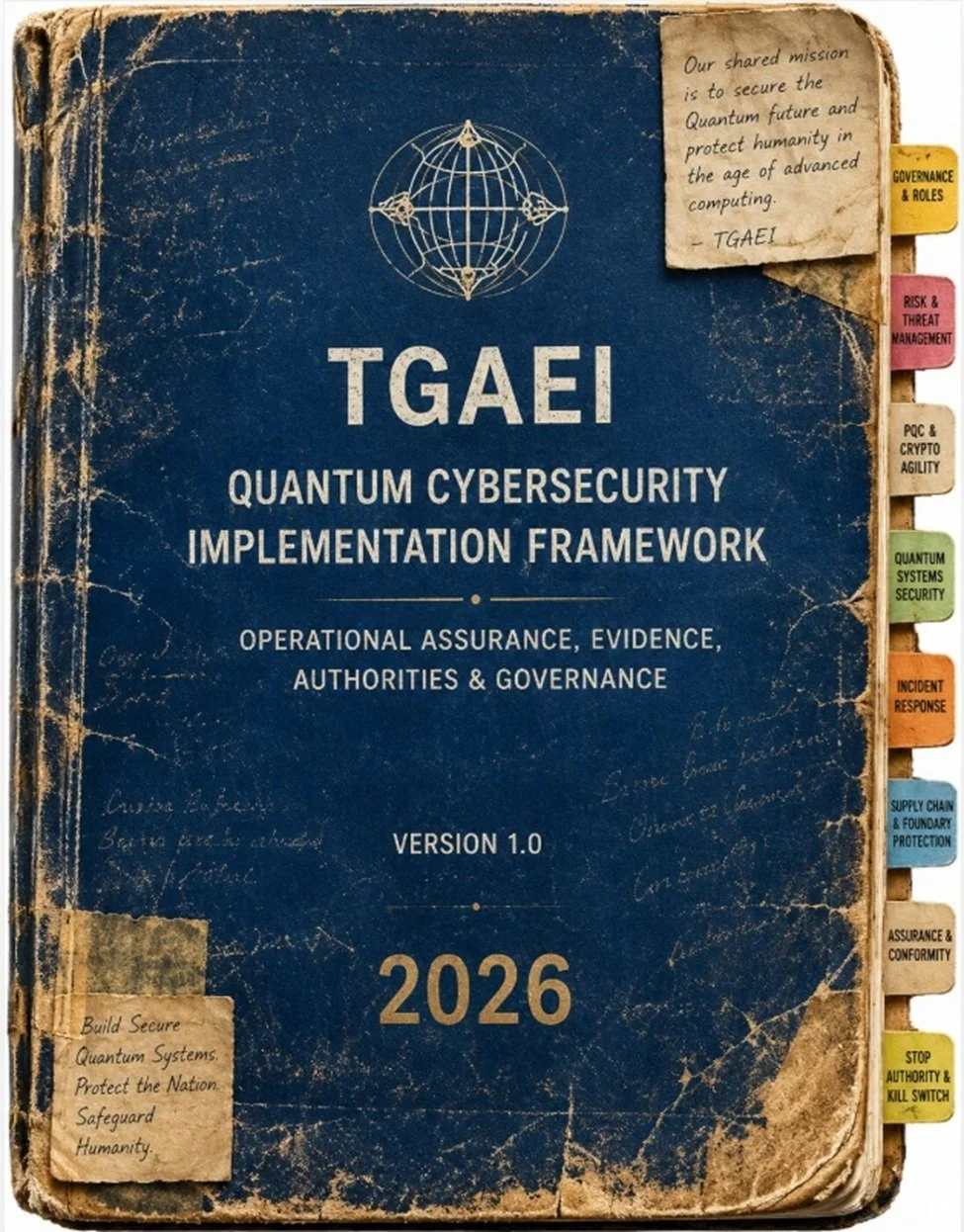
TGAEI—Quantum Cybersecurity Implementation Framework 2026
This manual can only be purchased on Amazon.com
This manual establishes a comprehensive implementation framework designed to operationalize the combined cybersecurity implications of Executive Orders 14412 and 14413. This is the consolidated edition: Chapters 1–21 and Appendices A through J, authored to the Chapter Architecture and Design Specification v1.0 and anchored throughout to the Standards and Frameworks Crosswalk v1.0. It carries an organization from first exposure determination through steady-state operation, and it is complete — no element of the Framework is reserved for later publication.
The architecture. Four parts, each answering a different question.
Part I — the operational core (Chapters 1–8) is jurisdiction-neutral and sector-neutral. Chapters 1–4 establish the foundation: the exposure model and dual-mandate screening (Chapter 1), the governance and accountability architecture (Chapter 2), cryptographic discovery and the CBOM (Chapter 3 with Appendix C), and quantum risk assessment and migration prioritization (Chapter 4 with Appendices D and E). Chapters 5–8 execute against it: algorithm selection and the Algorithm Authorization Record (Chapter 5), procurement and crypto-agility (Chapter 6), migration execution under the Master Migration Control Model (Chapter 7), and the standards watch, Consolidated Trigger Register, and evidence library that convert the campaign into a permanent function (Chapter 8).
Part II — jurisdictional overlays (Chapters 9–13) covers the United States across federal civilian, National Security Systems, and contractor strata (Chapter 9), the European Union (Chapter 10), the United Kingdom (Chapter 11), Asia-Pacific (Chapter 12), and Canada (Chapter 13). Overlays apply by determination, not by default: Procedure II.1 decides applicability, Procedure II.2 applies the delta, and Procedure II.3 resolves multiple applicable jurisdictions into one reconciled milestone calendar, one posture determination per system class, and one conflict log.
Part III — sector overlays (Chapters 14–17) addresses the four sectors where Part I's unstated assumptions break: operational technology and cyber-physical quantum systems (Chapter 14), financial services (Chapter 15), the defense industrial base and government contractors (Chapter 16), and telecommunications (Chapter 17).
Part IV — the novel governance layer (Chapters 18–21) governs the conditions no external instrument governs as a whole: dual-mandate governance and Stop Authority (Chapter 18), quantum supply chain, foundry, and benchmarking-data protection (Chapter 19), insider risk, research security, and counterintelligence integration (Chapter 20), and public-private boundary assurance (Chapter 21). These chapters bind by determination and exposure grade, not by organization type, and Chapter 18 supplies the authority into which the other three escalate.
The consolidated RACI library (Appendix B), the unified exception register and contract clause library (Appendix F), and the supplemental control and assurance overlay (Appendix G) support every part. Appendix H is the controlled glossary, Appendix I the References and Resources register, and Appendix J the Function Alignment Annex.